

By Patty G.
If you’re not familiar with the delightfulness that is Black Forager, aka Alexis Nikole Nelson, then you are missing out on a daily dose of happiness. She’s a forager and a cook and she takes folks on a feasting adventure by foraging, or searching for consumable foods found right in nature, with song and sometimes dance and with a little reminder to not die while foraging. Which is to say, don’t poison yourself by eating something that only looks friendly.
Nelson’s joyful approach to sustainability has made foraging feel accessible and fun, but it also underscores how few resources exist for learning to forage safely in specific regions. Our region specifically. I wish that there were more foragers in this area or that I knew who they are — or that there were more easily accessible centralized guides that could teach me how to eat the bounty of the desert without, ya know, poisoning myself. Searching for resources has led to few books, websites or classes tailored to the Chihuahuan Desert and the El Paso area. That’s not because our desert is void of things to eat; it’s because desert ecology is often misunderstood or underrepresented in mainstream food education.
Still, every now and then, someone comes along who bridges that gap — someone who turns curiosity and knowledge into community. One of my favorite tattoo artists in El Paso, Rory Carreon, happens to be an environmentalist, nature enthusiast and — huzzah! — local forager. She honed her ag skills through work at La Semilla Community Farm in Anthony, N.M., “a production, education, and demonstration farm guided by agroecology principles.” She’s now working at De Colores Farms and Foods, “one of the mentor farmer sites for La Semilla’s inaugural farmer fellowship.”
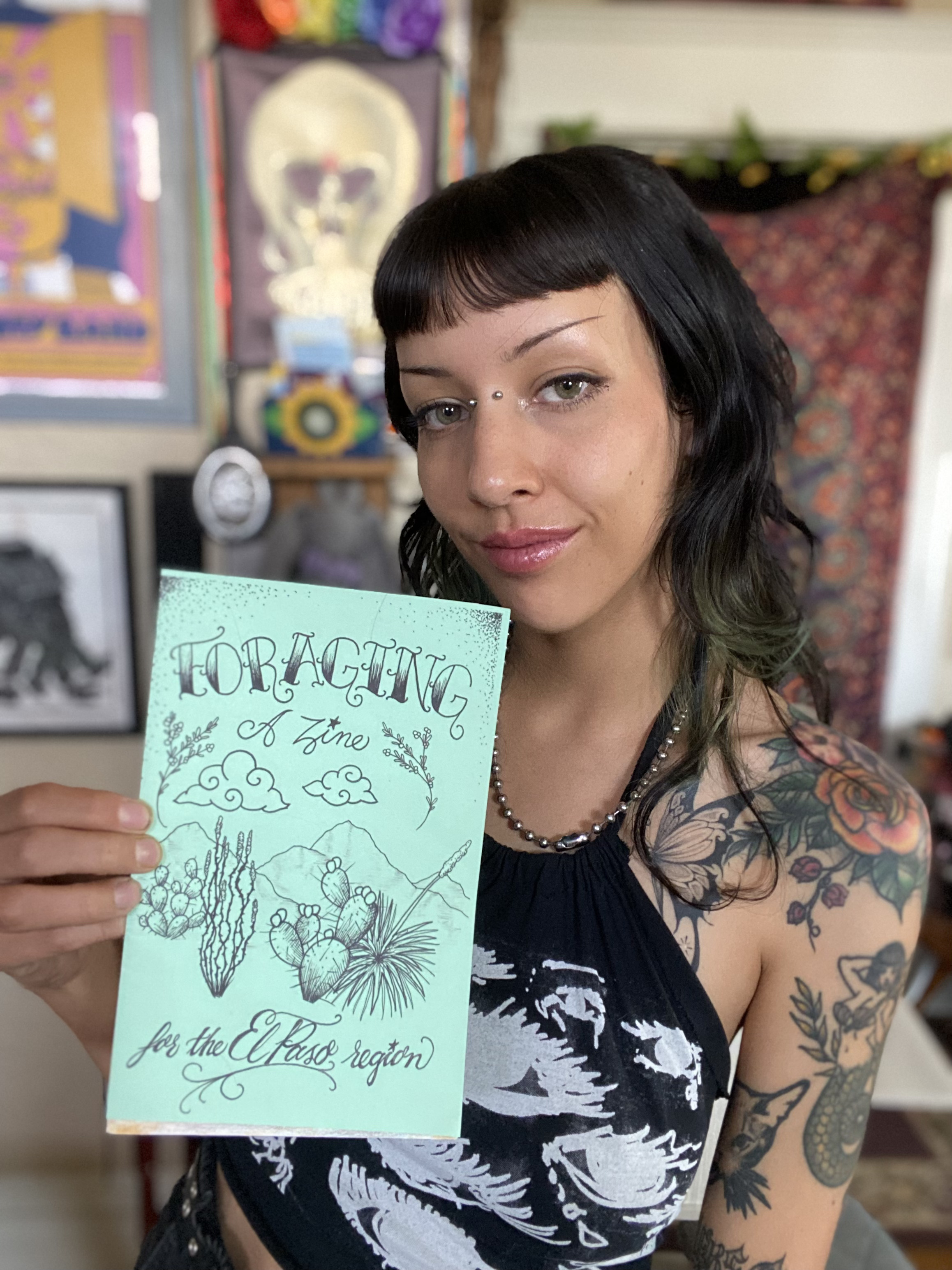
Carreon has combined her foraging know‑how with her illustration skills to help me not die by forage. She recently released a short zine, Foraging: A Zine for the El Paso Region, with illustrations — really beautiful illustrations, I might add — and photos of a few items you can easily find in El Paso and eat. Every page includes information on how to identify plants, its uses and any considerations you might need to know.
“It’s all about being able to identify the plants,” she says. “I tried to really make it in a way where it’s like an easy-to-digest gateway into what there is around us. I really hope that it could reach some people.”
“The desert is definitely underestimated. And in a way, I kind of want to say, because of how hard the living is out here, how much plants really need to be resistant to survive.”
She explains that the first part of her zine includes a land acknowledgement that reminds foragers to give a little bit of extra respect and care to the land as they forage. But more than that, she wanted her zine to show the resiliency of the desert and its people.
“The desert is definitely underestimated,” Carreon says. “And in a way, I kind of want to say, because of how hard the living is out here, how much plants really need to be resistant to survive. I want to say they have almost even more nutrition, like they’re just so packed with all kinds of amazing vitamins and healing properties that we don’t even really think about food as medicine, but a lot of the food that comes from the desert is also medicine.”
The zine offers tips on foraging safely and responsibly, along with a list of books Carreon used to create it, encouraging readers to do their own research. The zine does not include an exhaustive collection of edible plants in the Chihuahuan Desert, but it’s a starting point; a creative bridge between art and ecology that helps El Pasoans appreciate what’s around them and reconnect with forgotten knowledge.
“Foraging has always been something I’ve been interested in,” Carreon says. “There’s so much more about food that we don’t know because we’re kind of limited to what we usually buy at the store or what we grow in agriculture. The more I’ve been learning about de-colonial studies and native people’s practices and ways of life, I just feel like it’s such forgotten knowledge. That’s how I started taking it seriously and doing more research.”
Her time at La Semilla deepened her understanding of food systems. “Alternate institutions of food have been really interesting to me and also doing a little bit of time working at the community farm, too, has been really inspiring.”

For Carreon, that means foraging while on walks in her El Paso neighborhood. And though not nearly as abundant as when she was younger, foraging mulberries is still a treat. Beyond that, she enjoys when the pods of the palo verde tree start to show up.
“I put that one in my zine because that one is so abundant,” she says. “Pretty much on every walk I go on, I can find one. … the pods are gonna start forming, and that’s usually what I’ll eat. I’ll just, like, bust open the pods and eat the little beans inside, kind of like edamame.”
Like all good foragers, Carreon includes info about foraging ethically. I mean, you don’t want to hoard all the goodies for yourself and you don’t want to take so much that a plant can’t regenerate. Carreon says that typical etiquette says you should not harvest more than one-third of the piece of plant that you want. If the plant is considered a weed, you can take as much as you want.
There are just a few other rules to follow, like not taking from someone’s private property or from protected land. Also, you want to make sure you’re not foraging something that has been sprayed with chemicals or by animals. To learn more about responsible foraging, visit the Foraging Texas website: https://www.foragingtexas.com/p/foraging-ethics.html.
By foraging, Carreon says she has gained a better understanding of how abundant the desert really is. “I think another thing is you would think it’s mostly cactus, but there’s also yuccas, there’s also trees,” she explains. “And I think through doing this project too, it opened my eyes to how many trees we actually have. People are always like, ‘there are no trees.’ And it’s just not the trees that other folks might be used to. But we definitely have trees, like, we have a huge diversity of them, actually.”
In a place so often dismissed as barren, Carreon reminds us that the desert is not empty — it’s generous. You just have to slow down, look closely and learn its language. Her zine is an invitation to do exactly that: to see El Paso not as a landscape of scarcity, but as a living pantry, a teacher and a home worth knowing more deeply.
You can order Foraging: A Zine for the El Paso Region for $12 by direct messaging Carreon on Instagram: @rory.carreon.art.



Leave a Reply