


By Patty G.
On a warm weekday afternoon in November, Pancho Mendoza gives me a tour of his Central El Paso space. His office, with its dark blue walls, sits inside a building that doubles as a music school, a venue and a gathering place — a space he’s excited to share with the community.
Pancho Mendoza is a time capsule in motion. In my head, he is a granddaddy of the El Paso music scene. Now, this has nothing to do with age and everything to do with his OG status — Mendoza has been in the El Paso music scene for decades and his fingerprints are all over this city’s sound.
Generations of local musicians trace their roots back to him. One of them is El Paso mainstay Carlos Palacios, who credits Mendoza with welcoming him into the scene. When a legend calls you a legend, that’s more than praise — it’s proof of how deeply Mendoza has shaped the city’s musical ecosystem.
Felix Saucedo met Mendoza when they were teenagers running around the Lower Valley. The two eventually played in a band together.
“I was probably 13 when I met him,” Saucedo says. “We meshed well and he introduced me to skating but also the music — Bob Marley, Operation Ivy, all that stuff. We weren’t just liking it, we were discovering it together.”
In 1992, Mendoza founded the local ska/punk band Fixed Idea. The lineup has changed over the years, but the core has always been Mendoza: singer, guitarist, songwriter, engine. More than 30 years later, the band is still going.
But Mendoza isn’t stuck in the past. He’s building the next version of the scene.
His current hub is The Alley Cat — part venue, part bar, part community space. He’s already planning to expand it with a coffee shop, a merch store and a record shop. In October, he launched Chuco Arts and Entertainment, LLC, bringing together his work in music, teaching and community events where not just bands, but DJs and even poets can perform.

At the front of the building is Roots School of Music, where Mendoza has mentored countless young musicians — including his own children — passing down not just chords and scales, but a sense of culture and belonging. Outside the venue, he also works as a music teacher in the Ysleta Independent School District, bringing the same DIY spirit of punk and ska into the classroom.
“It’s something they’ve been around — it’s in their DNA now,” he says proudly.
Beyond his own children, he’s helping create a community for kids who may not feel like they fit in.
“He’s building people up, not just musically, but giving them confidence,” Saucedo says, explaining that Mendoza was the one who taught him how to play drums. “I couldn’t really keep a beat at first, but he patiently took his time and pushed me to the next level.”
Ask Mendoza about his students and he lights up. He starts listing names, talking about the bands they’ve started and the places they’ve gone, some even landing gigs with established groups like Slightly Stoopid. He’s proud of their accomplishments, but even more proud of the community they’ve built together.
The next step, he says, is continuing to grow the space: “Build up the venue where we could have people coming in and having fun, listening to music, enjoying the atmosphere.”
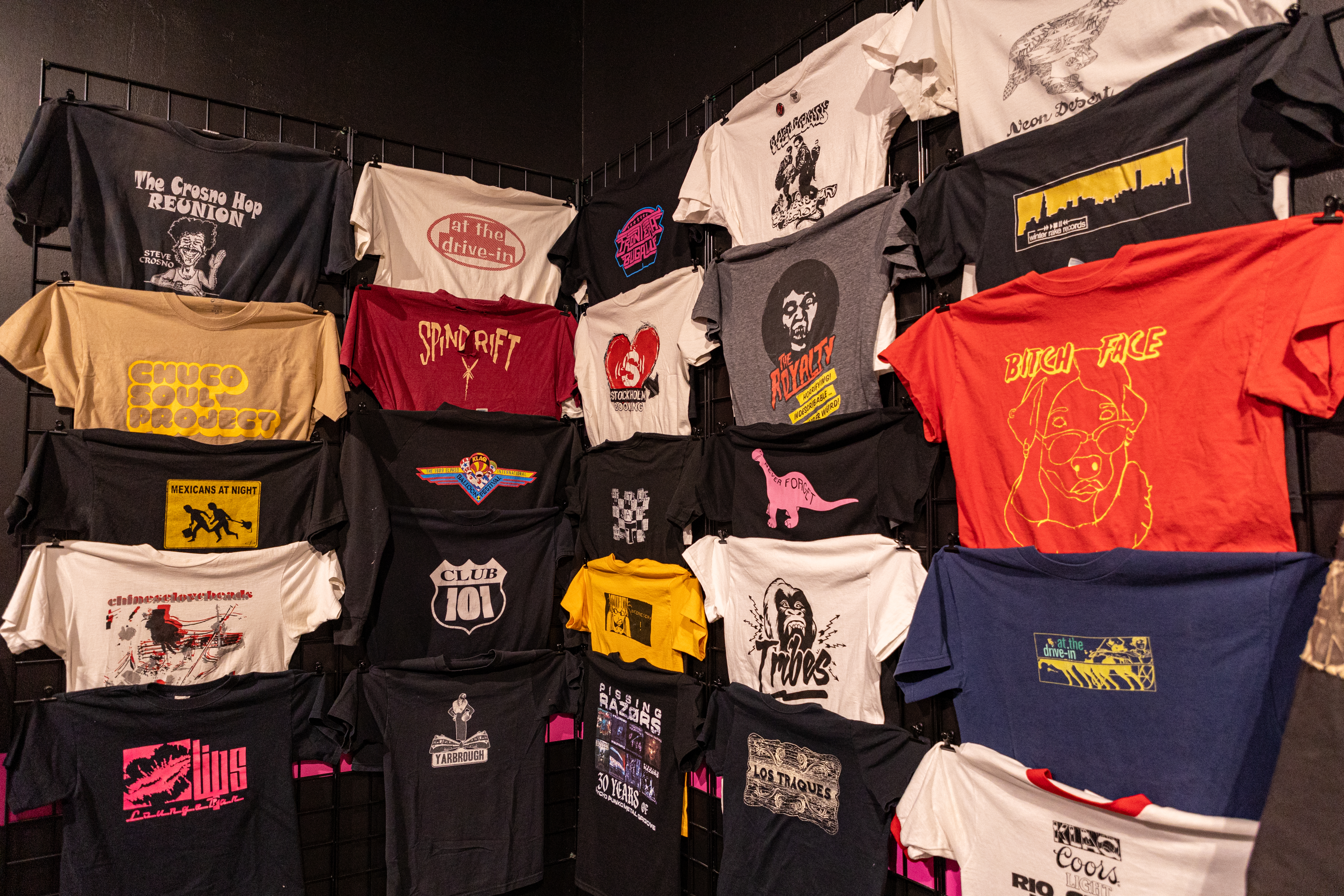
Step into Mendoza’s office near the front of the school and The Alley Cat and you’re stepping into decades of El Paso music history. Flyers, posters, magazine covers, instruments and photographs — artifacts from shows long past — cover the walls and fill cabinets in a collage of ink and memory. It feels less like décor and more like an archive.
As we talk about growing up in the Lower Valley, punk music and zines, he pulls out carefully preserved copies of zines he created years ago. They’re nearly pristine, but they carry the patina of lived experience — evidence of a scene built by hand, stapled together one page at a time.
Mendoza isn’t just part of El Paso’s music history. He’s been documenting it all along.
He grew up in Ysleta in El Paso’s Lower Valley, surrounded by music and drawn early to entertaining people. “Since I was a kid, I remember going to the parade that’s just down the street and listening to the bands playing,” he says. “My grandpa was a Shriner — he was in the El Maida Shrine band, so that inspired me.”
There were other early moments too. For his First Holy Communion, his parents hired a marimba band.
“I went up there with spoons and started playing,” he says.
Part of Mendoza’s punk ethos came from growing up without the things other kids had — and deciding to build his own identity anyway.
“I came from a single mom raising us, so yeah, we couldn’t buy nice shoes,” he says. “So what do we do? Go to the thrift store, buy combat boots. We couldn’t afford haircuts, so we’d shave our heads and get mohawks.
“I felt like I wasn’t part of society because I didn’t have what other people had. So I said, ‘Fuck it. I’m gonna be me.’”
He was introduced to punk music by his cousin Steven during family trips to Phoenix. That’s also where skateboarding entered the picture: his aunt and uncle had a halfpipe in their backyard. “Skateboarding and punk rock went hand in hand for me,” he says. “That’s how I grew up, since about fifth grade.”
He once asked his mom to order cassettes of Suicidal Tendencies, Misfits and Dead Kennedys. They never arrived — an aunt warned his mom it was “the devil’s music.” By then, though, he’d already heard them.
From that point on, Mendoza was all in. His early gear was whatever he could piece together. He stacked snare drums on bricks and hung a cymbal from a shoestring to build a makeshift drum kit. Later he learned guitar upside down because his friend Trace only had a right-handed guitar — and Mendoza is left-handed.
“I would just flip it over,” he says. “The strings were backwards. I just started playing like that.”
Eventually his mom bought him a left-handed guitar from a pawn shop. That guitar — a black (with white pickguard) Les Paul lawsuit-era guitar made in Japan — now hangs on the wall of his office. “She bought it for me for about $80, put it on layaway, and I started playing it.”

Back then, Mendoza and his friends started throwing backyard shows for one simple reason: they were underage. If they couldn’t play the bars, they built their own scene. “We would hold car washes and buy beer. I don’t know how we got keggers,” Mendoza laughs. “But that’s how we put on backyard punk shows.”
They made noise. They invited friends. They figured it out.
At first his bands played straight punk — until he heard Operation Ivy.
“That changed everything,” he says. “I was like, ‘What is this? This is dope. This is different.’ That’s when I started creating songs with the upbeats and stuff.”
That sound pushed him in a new direction and eventually led to Fixed Idea. The band formed with Mendoza on guitar, his brother Raul — whom he had taught to play — on drums, Phil Heimer on bass, Stephen Heimer on trumpet and Eddie Garcia on trombone.
Before that lineup stuck, though, things were loose. Kids wanted to get into shows for free, Mendoza says, so whoever had an instrument became part of the band — even if it was just for one show.
Saucedo remembers those early shows the same way.
“It was total punk rock — just get it done,” he says. “Most of the time it was backyard shows. Somebody would open their house, their yard, and bands would play.”
“You didn’t realize it at the time,” he says. “But some really good bands came through those shows.”
“I’m very happy and very grateful for the fans and the family that have always pushed us,” Mendoza says. “These songs are still relevant today.”
More than three decades later, Fixed Idea is still playing. “I’m very happy and very grateful for the fans and the family that have always pushed us,” Mendoza says. “These songs are still relevant today.”
He credits the band’s longevity to passion and persistence and to people who helped along the way, including a DJ named Augustus who played their music on a Sunday show on 89.5 FM in the 1990s.
“The music still strikes a chord,” Mendoza says. “People still connect with it. I’ve been blessed.”
Over the years, Mendoza has also built infrastructure for the scene. At one point he ran a record label called Broken Bones, which featured eight bands including Hot Rod Boogie. The label eventually closed, but Mendoza is already thinking about the next version. A new Fixed Idea record is in the works. A tour is coming. He’s also planning a recording studio — and possibly another record label.
For Saucedo, watching Mendoza build new spaces for music — from the Roots School of Music to The Alley Cat — feels like a continuation of what they started decades ago.
“We grew up doing backyard shows,” he says. “Now he’s creating a place where that same spirit can live again.”
Pancho Mendoza’s legacy stretches across decades of El Paso music — from xeroxed zines to packed local shows, from backyard punk gigs to full-blown institutions. He’s not just preserving the city’s music history. He’s still building it.
For Your Listening/Viewing Pleasure
Fixed Idea on Instagram: https://www.instagram.com/fixedidea
Fixed Idea on YouTube: https://www.youtube.com/@FixedIdea69



Leave a Reply